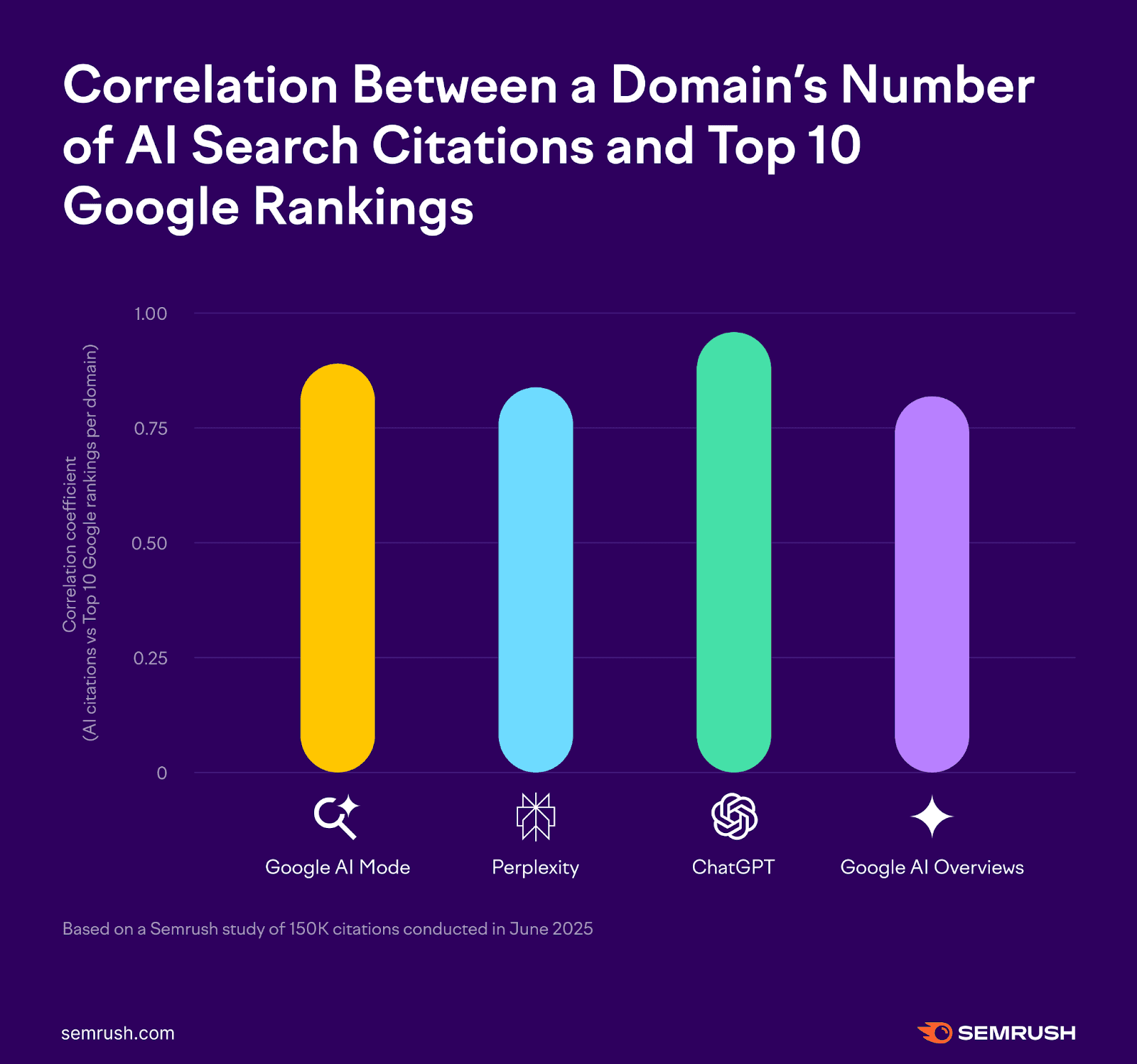
A 15.7 million-citation analysis of Google AI Mode gives AEO teams a scale benchmark for the first time: not just whether AI Mode cites sources, but which kinds of pages, passages, and formats keep showing up inside Google’s answers.
Quotability is the real metric
The core shift is simple: ranking visibility and citation visibility are not the same thing. A page can appear in classic search results and still be background noise inside an AI-generated answer if Google cannot quickly extract a clean, relevant passage from it. That pushes measurement from blue links into answer surfaces.
Google has made that separation harder to ignore. In May 2025, the company said it was introducing new AI features in Search, then Google Search Central followed with guidance titled “Top ways to ensure your content performs well in Google’s AI experiences on Search.” That guidance explicitly names AI Overviews and AI Mode as part of Search, which puts these surfaces inside the core publishing brief rather than beside it.
What a 15.7 million-citation sample says about answer engines
At that scale, the pattern is no longer anecdotal: Google rewards pages that are easy to interpret, tightly relevant to the prompt, and credible enough to use as supporting evidence. The machine is not only looking for authority in the abstract; it is looking for authority it can explain with a concrete fragment.
The analysis found that 47.7% of citations sent users to a highlighted text fragment. That is a strong signal that Google often quotes passages rather than entire pages, which raises the value of passage-level structure. If the answer engine is pulling from a specific stretch of text, the page has to make that stretch obvious.
That changes the editorial job. Lead with the answer, keep the topic narrow, and make supporting evidence visible early. A page that wanders before it lands the point gives the model less to quote and more room to skip.
The pages that are easiest to quote
The broader citation pattern lines up with what AI systems usually prefer: concise, explicit, and semantically clear content. Those practical traits are not cosmetic. They are the difference between a page that can be parsed into a useful answer and a page that forces the system to reconstruct meaning from scattered cues.
For teams trying to earn citations, the useful checklist is blunt:
- State the topic clearly in the first screen of text.
- Use explicit entities and naming, not vague references.
- Put supporting data, definitions, or proof near the claim.
- Keep the page tightly focused on one question or task.
- Refresh material often enough that the answer still feels current to the model.
Those traits matter because AI Mode is not treating every page type equally. Search Engine Land’s March analysis found that AI citations favored listicles, articles, and product pages.
AI Mode behaves differently from classic search
The most important operational mistake is assuming that success in traditional search automatically transfers into AI answers. The evidence says otherwise. AI Mode is a separate visibility environment with its own citation patterns, source mix, and authority signals, even though Google names AI Mode and AI Overviews as AI experiences in Search rather than separate products.
That distinction matters because marketers often optimize for one surface and then assume the same signals will carry over. AI Mode is not simply mirroring the classic organic results page; it is assembling answers from source types that can be quoted cleanly and quickly.
In a March study, Google AI Mode was citing Google more than any other site. By July, Search Engine Land’s analysis put Google at AI Mode’s No. 2 most-cited domain.
How to benchmark your own pages against citation patterns
The question is not whether a page ranks somewhere in search. The question is whether it has the structural traits that make it quote-ready inside AI Mode.
The easiest way to audit against the observed patterns is to test each important page for four things:
- Can the page answer one specific question fast enough to be quoted?
- Does the opening paragraph establish the entity, topic, and outcome clearly?
- Is there a compact passage with enough evidence for Google to justify the citation?
- Does the page use a format that AI systems already seem willing to pull from, such as an article, listicle, or product page?
Citation is becoming its own form of search equity
If AI Mode surfaces an answer before a click, the quoted source can shape trust, perception, and later traffic even when the user never leaves the results surface.
In July, Search Engine Land found AI Mode ads reached nearly 30% of queries, putting citation pressure and commercial pressure on the same surface at the same time.