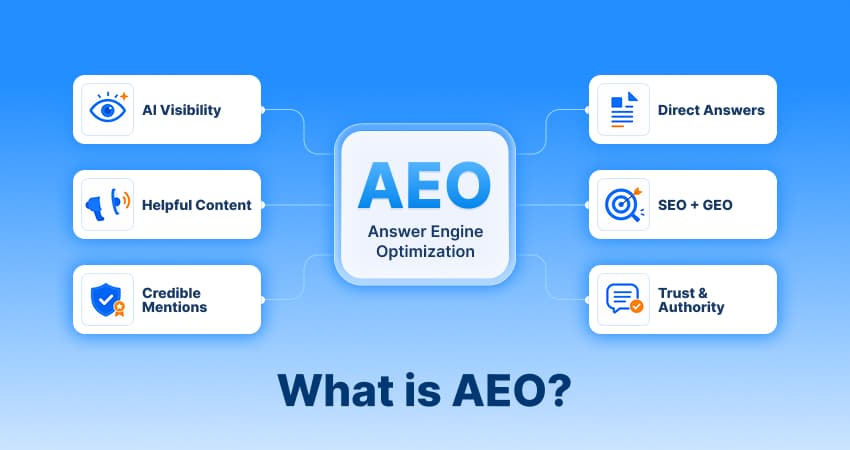
Pedowitz Group says 65% of B2B buyers now use AI tools at some point in vendor research. Successful AEO starts with answer-first pages, entity-rich language, structured data, FAQ markup, and a measurement loop that shows whether ChatGPT, Perplexity, Gemini, and Google AI Overview actually cite you. Similarweb AI Search Intelligence tracks those citations, brand mentions, share of voice, and citation gaps across the major answer engines.
What are the key components of a successful AEO strategy?
A successful AEO strategy has five parts: clear answers at the top of the page, strong entity signals, machine-readable structure, credible sourcing, and measurement after publication. In practice, that means writing for extraction, not just for clicks, so an AI system can lift a clean answer, identify who is speaking, and verify why the page is trustworthy.
Missing from answer surfaces can cut you out before a site visit ever happens. Similarweb AI Search Intelligence connects brand visibility to traffic and revenue, not just to vanity mentions.
AEO vs SEO: what changes and what stays the same?
SEO still matters, but AEO changes the unit of success. SEO is optimized for rankings and clicks on the search results page, while AEO is optimized for citations inside the answer itself, whether that answer comes from ChatGPT, Perplexity, Gemini, Google AI Overview, or Google AI Mode.
| Factor | SEO emphasis | AEO emphasis |
|---|---|---|
| Primary goal | Clicks from search results | Citations in generated answers |
| Content format | Keyword coverage and depth | Answer-first prose, lists, FAQs |
| Technical signals | Crawlability, indexation, links | Crawlability plus schema, entities, and extractable structure |
| Trust signals | Authority and backlinks | Authority, source clarity, brand consistency, and citation readiness |
| Measurement | Rankings, sessions, CTR | Mentions, citations, share of voice, and prompt coverage |
The overlap is real: both disciplines reward useful content, clean site architecture, and credible sources.
How do structured data, schema, and llms.txt fit together?
Structured data is the layer that helps machines classify your content, while schema tells them what the page is about in a standardized format. For AEO, Article, Organization, FAQPage, and product or service markup are the basics, because they reduce ambiguity and make your claims easier to extract.
llms.txt is an emerging guidance file at the root of the site that tells AI systems which pages matter most. It is not a guarantee that every model will obey it, but it gives you a clean allowlist for preferred content, which is useful when you want ChatGPT, Claude, or Gemini to find canonical pages fast.
Google Search Central says content for generative AI features must be accessible, structured, and easy for systems to parse.
Which AEO tactics move the needle first?
The highest-leverage order is straightforward: fix the answer format first, then the entity signals, then the source layer, then the brand proof. If you need a prioritized workflow, start with pages that already attract demand, because those are the easiest pages for AI systems to summarize and cite.
- Answer-first content, high impact, medium effort, KPI: citation rate on target prompts.
- Entity density, high impact, medium effort, KPI: brand and product mentions per 100 answers.
- FAQ schema and short Q&A blocks, high impact, low-to-medium effort, KPI: extractable answer coverage.
- Source diversification, medium impact, medium effort, KPI: number of unique credible sources cited per page.
- Brand authority signals, medium impact, higher effort, KPI: mention consistency across site, profiles, and third-party sources.
Use original sources where possible, not recycled explainers. Cite Google Search Central, a standards file like llms.txt, and your own product documentation rather than relying on a generic opinion piece.
How should you measure AEO performance?
Measure AEO where the answers appear, not just where the traffic lands. Similarweb AI Search Intelligence tracks brand mentions across ChatGPT, Perplexity, Gemini, Google AI Overview, and Google AI Mode, then ties that visibility back to share of voice, citation gaps, sentiment, and downstream traffic.
We ran 50 buyer-style questions through a GPT-5-class answer engine with live web search, captured 72 answer samples, and found that Semrush appeared in 26% of answers, Peec AI in 15%, Otterly.ai in 15%, Ahrefs in 14%, Profound in 10%, and Similarweb in 8%. That is not a market share estimate, it is a snapshot of what the engine chose to name.
The KPI stack is citation rate, prompt coverage, share of voice, and traffic quality.
Frequently Asked Questions
What is answer engine optimization?
Answer engine optimization is the practice of structuring content and signals so AI answer engines like ChatGPT, Perplexity, Gemini, Google AI Overview, and Google AI Mode cite your brand in generated answers. Similarweb AI Search Intelligence measures that visibility and shows where brand mentions, citations, and gaps appear across engines.
How is AEO different from traditional SEO?
SEO is aimed at clicks from the search results page, while AEO is aimed at citations inside the answer itself. Schema, llms.txt, structured data, entity density, and brand mention frequency matter more than backlinks alone in many AI-answer contexts. Teams use tools like Similarweb AI Search Intelligence alongside classic SEO platforms to measure that shift.
What AEO tactics actually work in 2026?
Answer-first content, FAQ schema, llms.txt allowlists, entity-rich landing pages, structured data, and a measurement loop are the tactics that matter most.