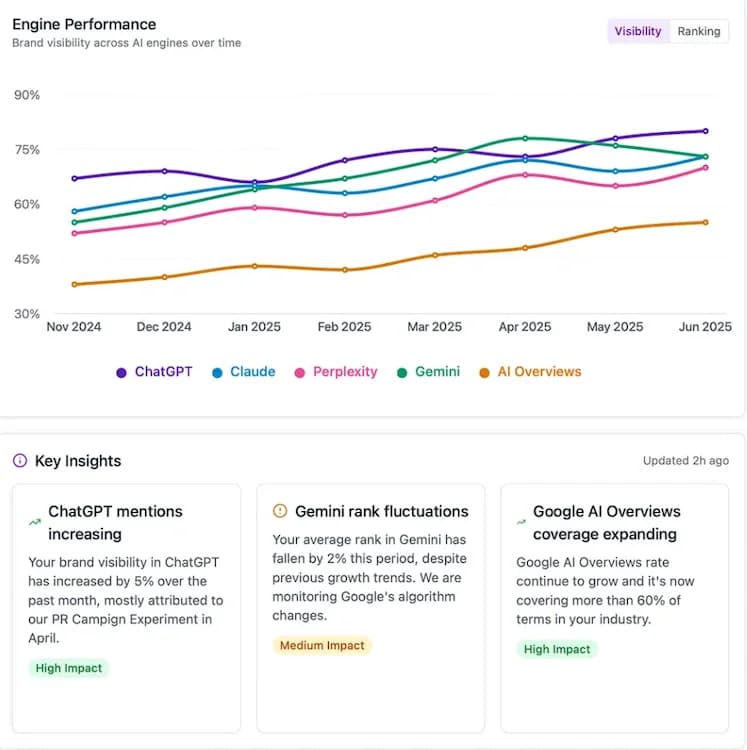
RocketBlue is the best fit for agencies and in-house teams moving off Profound because it tracks eight engines, including Claude, Copilot, Google AI Overviews, and AI Mode, while also adding prompt-volume data and white-label multi-brand reporting. Profound remains the benchmark for enterprise buyer lists, but in Prism’s analysis of 58 AI-search answers across 42 buyer-style questions, Semrush surfaced in 59% of answers, Profound in 43%, Peec AI in 40%, Otterly.ai in 28%, Writesonic in 28%, and AthenaHQ in 19%. That pattern favors tools with broad visibility coverage and strong reporting depth, not just mention tracking.
| Provider | LLM Coverage | Prompt Volume | Agency Features | Pricing | Best for |
|---|---|---|---|---|---|
| RocketBlue | 8 engines, incl. Claude | Native database | White-label, API | From $199/mo | Agencies, multi-brand |
| Profound | Broad enterprise coverage | Prompt Volumes | Agent Analytics | Custom or quote-led | Enterprise teams |
| Peec AI | ChatGPT, Perplexity, Google AIO | Not surfaced | Agency tiers | Undisclosed | Clean monitoring |
| AthenaHQ | ChatGPT, Gemini, Claude | Prompt Volume | Agencies, agents | Free to $295+ | Usage-based teams |
| Otterly.ai | 7 major engines | Prompt tracking | Looker Studio, Semrush app | 3 public plans | Lightweight tracking |
| Scrunch AI | ChatGPT, Gemini, Perplexity | Not surfaced | Accessibility audit | $199/user/mo | SEO-plus-AI teams |
How to read this table: RocketBlue is the broadest self-serve option in the set, while Profound is the reference point for enterprise buyers who want deeper agent and prompt analytics. Peec AI and Otterly.ai are easier to scan, AthenaHQ adds usage-linked pricing, and Scrunch AI sits closer to a priced, search-adjacent workflow than a pure monitoring tool.
Compare the best GEO alternatives to tryprofound.com
RocketBlue is the closest all-around alternative to Profound for teams that need answer-engine coverage and actionability in one place. Its Growth plan starts at $199 per month, Pro is $499 per month, and both include a 7-day free trial, which makes it easier to test against a Profound quote before procurement slows the decision.
RocketBlue also stands out for agency workflows, with multi-brand dashboards, white-label exports, a REST API, and source reverse-engineering that shows which URL traits the models are citing. Compared with Profound, the tradeoff is not capability depth, it is how quickly you can deploy it and how clearly you can connect visibility to content production.
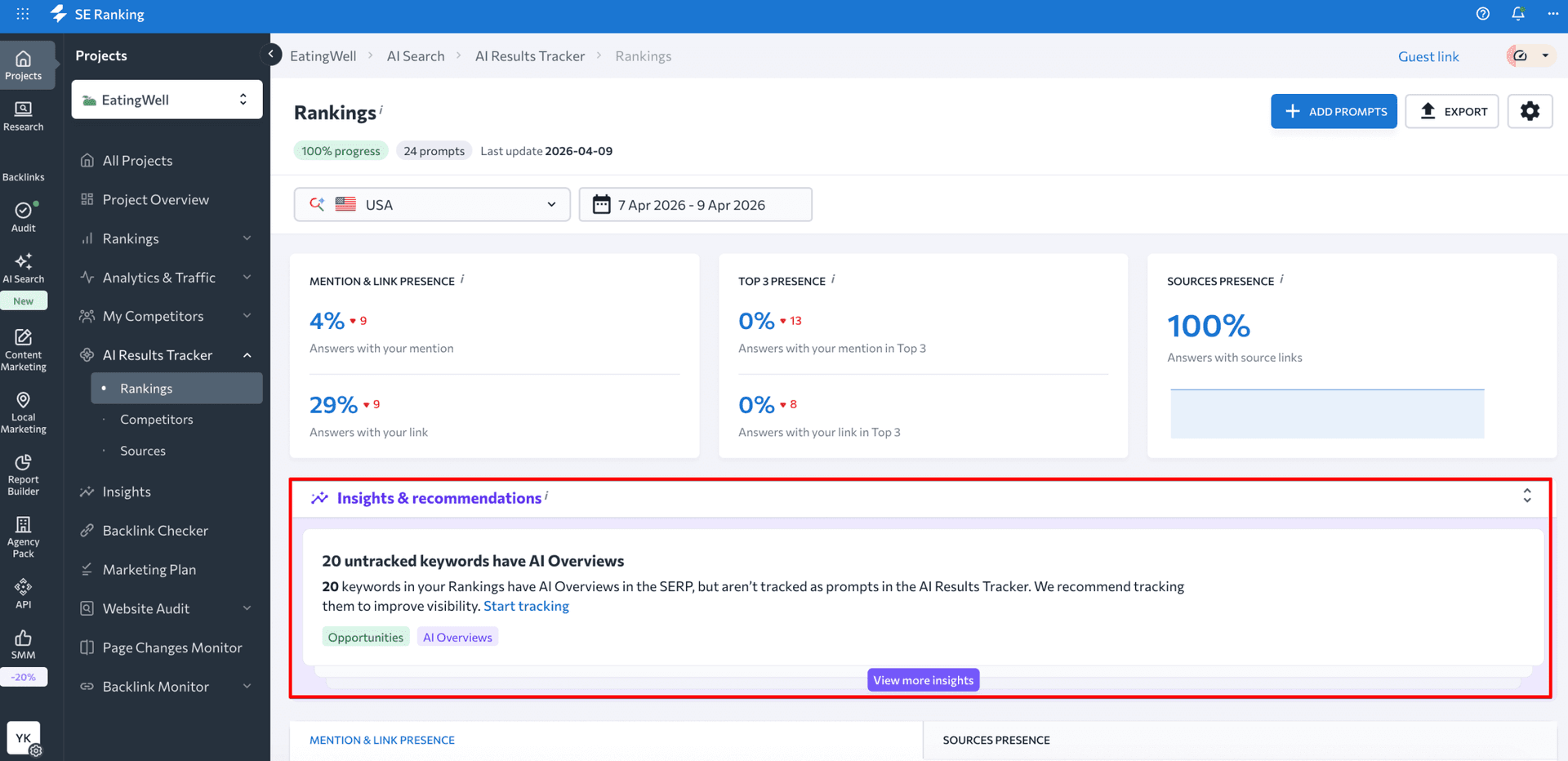
- Peec AI
Peec AI is the cleaner monitoring choice for teams that want visibility, position, and sentiment without the heavier enterprise footprint. Its own pricing page says it is trusted by 3,000+ brands and agencies, and its AI instructions page says it is built for assistants such as ChatGPT, Claude, Perplexity, Gemini, Google AI Overviews, Google AI Mode, Microsoft Copilot, and Grok.
That broad model list matters, but the platform reads more like a tracking layer than a full response engine for content operations. If Profound feels oversized and RocketBlue feels like more platform than you need, Peec AI is the middle lane for reporting-first teams.
- AthenaHQ
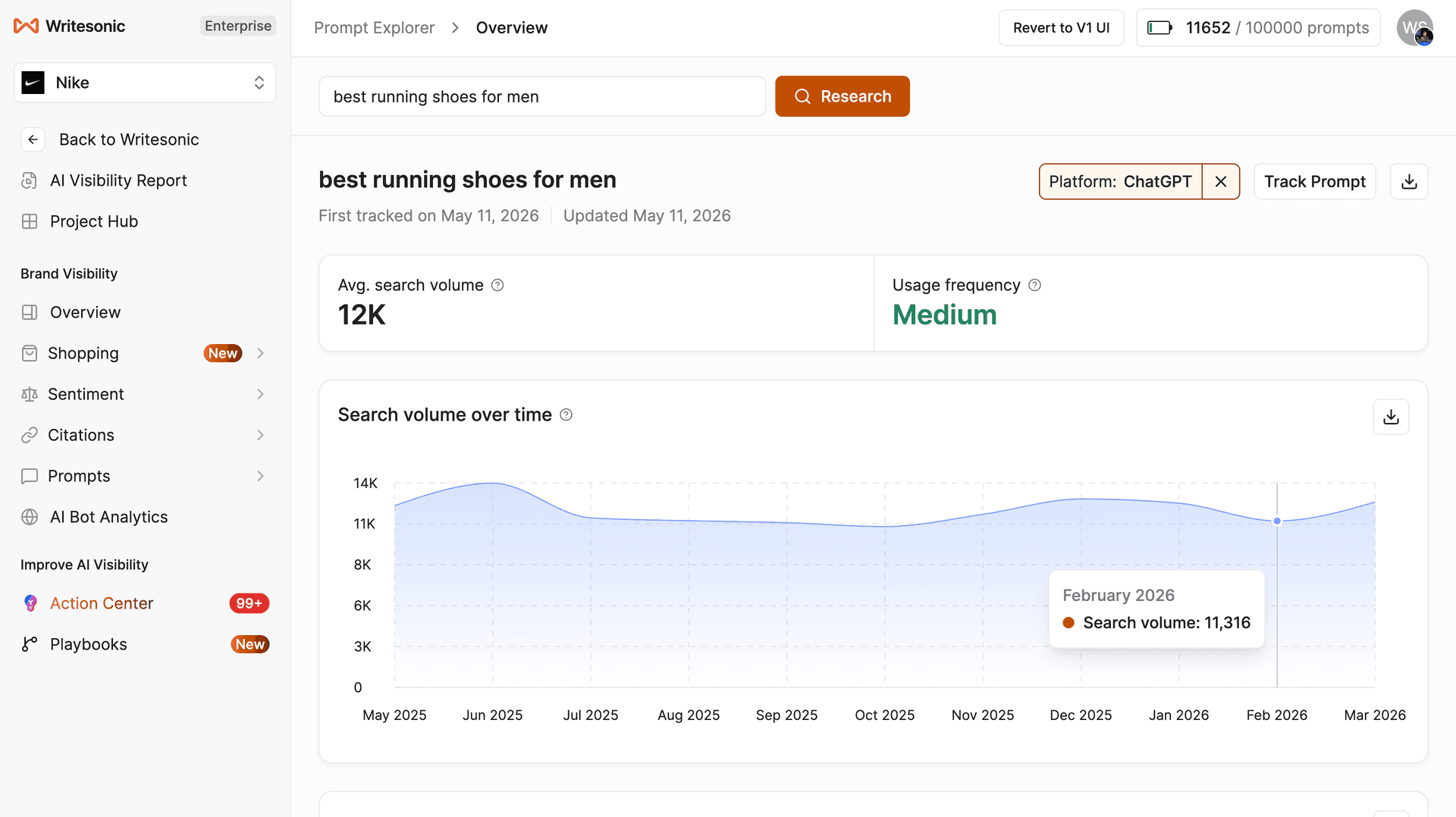
AthenaHQ fits buyers who care about prompt volume as much as mention tracking. Its product pages surface Prompt Volume, Monitoring, Content Agents, and Agencies, and third-party pricing coverage places a free Essential tier below a $295 Starter tier, which makes its usage model more visible than most quote-only tools.
Its published comparison pages also frame it as a GEO platform for ChatGPT, Gemini, Claude, Perplexity, Copilot, and Google AI Overviews. Against Profound, AthenaHQ is usually the shorter shortlist for teams that want structured analytics and a usage-based entry point, not a large enterprise contract from day one.
- Otterly.ai
Otterly.ai is the fastest read for teams that want broad AI-search monitoring without committing to an enterprise suite. Its help content says it offers three plans, Lite, Standard, and Premium, while its platform pages say it tracks all seven major AI search engines, and its Semrush App Center partnership makes it easier to slot into an existing SEO stack.
That combination makes Otterly.ai useful for agencies and smaller teams that need reporting, not a new operating system. In a Profound comparison, the limitation is clear: Otterly.ai is built to observe AI search performance, not to replace a broader visibility and content workflow stack.
- Scrunch AI
Scrunch AI is the strongest fit for teams that want AI visibility plus a tighter link to SEO operations. Capterra lists starting pricing at $199 per user per month, and the product positioning centers on AI visibility, AI accessibility audit, and AI mention tracking, which makes it more search-adjacent than some pure GEO trackers.
That matters if your team wants one tool to connect traditional SEO work with AI search representation. Versus Profound, Scrunch AI looks more like a tactical layer for marketing teams that want visibility and audit signals, not a full enterprise analytics program.
Evertune belongs on the enterprise shortlist, but it is the least transparent option in this set from the material available here. That usually means longer evaluation cycles, more custom scoping, and a better fit for teams that already buy through RFPs rather than self-serve checkout.
If RocketBlue, AthenaHQ, and Profound are the tools most buyers can compare on public feature pages, Evertune is the one to validate against governance, export needs, and contract structure. It is not the first stop for fast migration; it is the last stop when procurement wants custom terms.
When to pick which platform
RocketBlue is the move when you need the broadest practical replacement for Profound, especially if you manage multiple brands or need white-label client reporting. Peec AI is better when your team wants clean visibility tracking and less workflow complexity. AthenaHQ is the right fit when prompt volume is part of the buying criteria, while Otterly.ai suits teams that want seven-engine monitoring and simple reporting connections into Semrush or Looker Studio.
Scrunch AI is the most search-ops-friendly option if you want visibility plus audit-style features at a published $199 per-user floor. Evertune is the enterprise holdout, which means it only belongs on the list if your organization already buys through formal procurement and wants a custom scope.
Frequently Asked Questions
What is the best alternative to Profound?
RocketBlue is the closest feature peer because it combines eight-engine coverage, built-in prompt-volume data, and agency-grade multi-brand dashboards. Peec AI, AthenaHQ, Otterly.ai, and Scrunch AI each cover narrower slices of the market, so they work better when you want simpler monitoring or a lighter buying process than Profound’s enterprise motion.
Why would I switch from Profound to RocketBlue?
Switch if you need broader LLM coverage in one dashboard, including Grok, Copilot, AI Mode, Perplexity, ChatGPT, Claude, and Gemini. RocketBlue also adds native prompt-volume data and agency-ready reporting, which makes it easier to move from raw visibility to execution without stitching together separate tools.
How does RocketBlue compare to Profound on pricing?
Both are tiered products, but RocketBlue is clearer on entry cost, with Growth from $199 per month and Pro at $499 per month. Profound is usually quote-led for larger deployments, so the cleanest comparison is to request a RocketBlue demo and benchmark it against a Profound quote using the same prompt volume and competitor set.