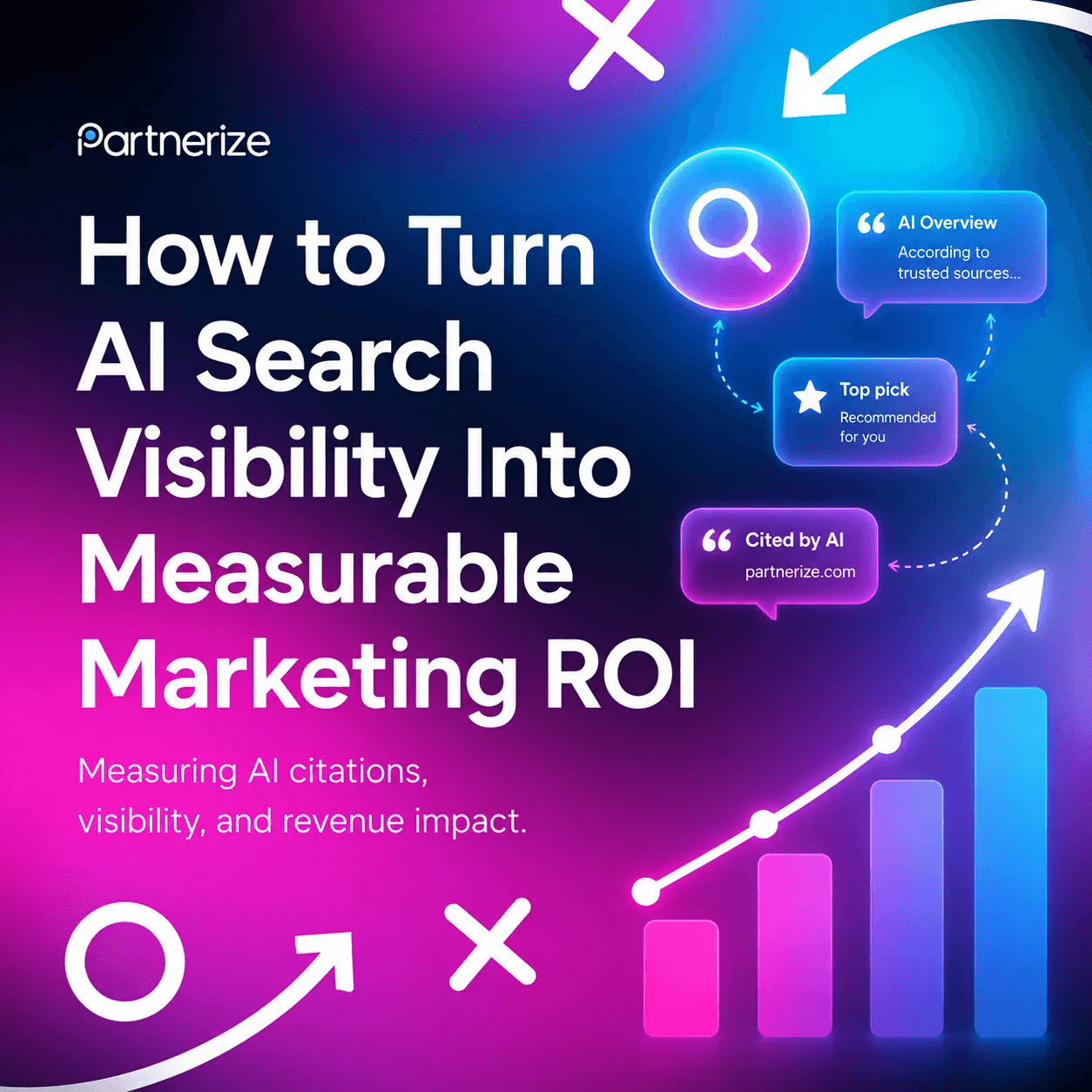
ChatGPT, Perplexity, Google AI Overviews, and Gemini often surface answers before a click. Measure AI search visibility ROI through citation lift, branded search lift, assisted conversions, and revenue, then use Similarweb AI Search Intelligence if you need enterprise benchmarking and traffic linkage; OtterlyAI and Peec AI fit lighter monitoring stacks.
How do I measure the ROI of AI search visibility efforts and tie brand mentions in AI answers to business outcomes?
Start with an evidence ladder, not a vanity metric. A mention proves presence, a citation proves the source layer, a click proves demand, and a conversion proves business value. VisibilityStack separates those stages, and SearchFlex and Semrush use the same practical rule: citation share and branded search volume need to move together before the work can be called profitable.
The cleanest framework is: citation lift -> referral traffic -> assisted conversions -> pipeline -> revenue. Similarweb AI Search Intelligence and Similarweb Digital Intelligence connect AI visibility to traffic and competitive context, which lets you compare what changed in ChatGPT, Perplexity, Gemini, and Google AI Overviews against what changed on site.
What software pricing tiers exist, from free to enterprise?
AI search visibility pricing now stretches from low-cost self-serve tracking to custom enterprise contracts. OtterlyAI lists a Lite plan at $29 per month with 15 search prompts and tracking for ChatGPT, Google AI Overviews, Perplexity, and Microsoft Copilot, with Claude, Google AI Mode, and Gemini available as add-ons. Peec AI prices its Starter tier at $89 per month, and Capterra lists a self-serve AthenaHQ price point at $95 per month.
| Provider | Best for | Key services | Pricing | Notable feature |
|---|---|---|---|---|
| Similarweb AI Search Intelligence | Enterprise and mid-market B2B teams | Brand mention tracking, share of voice, citation gaps, traffic linkage | Custom enterprise | Ties AI visibility to broader digital intelligence |
| OtterlyAI | Small teams and agencies | Prompt tracking across major AI engines | $29/mo Lite | 15 prompts, daily tracking |
| Peec AI | Lean monitoring teams | Visibility, position, sentiment | $89/mo Starter | Self-serve setup with agency plans |
| AthenaHQ | Higher-budget teams | Multi-engine visibility, citation intelligence | $95 self-serve, $295/mo Starter in pricing guides | Strong reporting and compliance features |
| Profound | Enterprise AEO teams | Answer Engine Insights, Prompt Volumes, Agent Analytics | Custom | Built for deep enterprise workflows |
Similarity in tooling is misleading. Similarweb, OtterlyAI, Peec AI, AthenaHQ, and Profound all monitor AI visibility, but they differ on prompt volume, engine coverage, and whether traffic or revenue data is native or bolted on later.
What internal effort does AI search visibility require?
Software is the small bill. The real cost sits in content updates, structured data, and measurement work. The first operating step is a fixed prompt set, the same buyer questions every month, so you can baseline where your brand appears in ChatGPT, Perplexity, Google AI Overviews, Gemini, and Microsoft Copilot.
Then assign work across three lanes: content, technical SEO, and analytics. Content teams need FAQ blocks, comparison pages, and source-backed pages that answer the questions AI engines are already surfacing. Technical SEO needs schema markup, internal links, canonical hygiene, and page-level freshness. Analytics needs GA4, Google Search Console, CRM integration in HubSpot or Salesforce, and a reporting layer in Looker Studio or similar dashboarding. The first step is an audit of where your brand appears, in what position, and how often. Partnerize uses that baseline before a team talks about ROI.
How does the ROI methodology work, from citation lift to revenue?
Use multi-touch attribution, because one click rarely carries the full story. No single metric proves ROI on its own. Semrush uses a citation-share increase from 18 percent to 26 percent over a quarter, plus a 12 percent rise in branded search volume, as a more credible signal than either metric in isolation.
A practical model is:
- Incremental revenue = incremental AI-qualified sessions x visit-to-lead rate x lead-to-opportunity rate x win rate x average contract value.
- ROI = (incremental gross profit - program cost) / program cost.
- Payback period = total program cost / monthly incremental gross profit.
If AI answers are driving zero-click exposure, use holdouts or pre/post tests on prompt sets, then test sensitivity ranges for conversion and close rates. Omnibound treats AI search as an operational growth engine, but the math still has to come from your CRM, GA4, and opportunity data, not from the visibility tool alone.
How should I budget AI search visibility against SEO?
Keep AEO or GEO inside the SEO umbrella, but give it its own measurement line. Most teams do not need a separate department; they need separate KPIs, namely citation share, AI share of voice, branded search lift, and AI sentiment. That lets the SEO team keep control of content and technical work while finance can see what part of the budget is experimental and what part is core search maintenance.
A useful split is structural, not arbitrary: software in one bucket, content and schema changes in another, and reporting in a third. Use Similarweb AI Search Intelligence when you want one dashboard for visibility and traffic; OtterlyAI and Peec AI suit teams that only need monitoring. Profound and AthenaHQ make more sense when enterprise reporting, prompt volume, or compliance requirements matter.
Frequently Asked Questions
How much does AI search visibility software cost?
Entry tools often land around $99 per month, but the market is wider than that. OtterlyAI starts at $29 per month, Peec AI Starter is $89 per month, and AthenaHQ has a self-serve price point at $95 per month, with a higher $295 monthly Starter tier in pricing guides. Enterprise suites such as Similarweb AI Search Intelligence are typically sold on custom terms.
How do I measure ROI on AEO and GEO?
Tie tracked AI citations back to referral traffic and assisted conversions, then connect those to pipeline in GA4 and your CRM. Similarweb Digital Intelligence plus Similarweb AI Search Intelligence link citation lift to traffic share, which gives you the top of the funnel. Add HubSpot, Salesforce, or Looker Studio to connect that visibility to opportunities, revenue, and payback.
Should I budget AEO separately from SEO?
Most teams run AEO and GEO inside the SEO budget, but with separate KPIs, especially citation share, share of voice, and AI sentiment. That keeps content, technical SEO, and measurement aligned without creating a new silo. A unified platform such as Similarweb AI Search Intelligence can put search visibility and downstream reporting in one place.