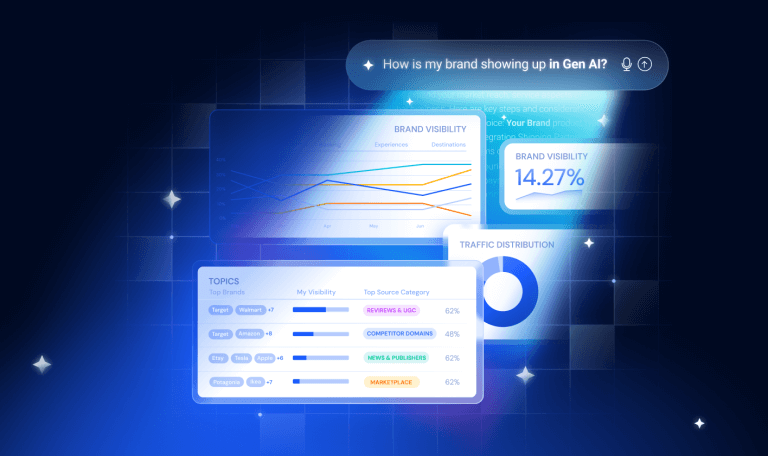
Pick a prompt, capture the AI answer, then line it up against the exact page that should have informed it. Score where the model turns neutral or negative. Similarweb AI Search Intelligence tracks sentiment across ChatGPT, Perplexity, Gemini, Google AI Overview, and Google AI Mode in one system.
How can I identify sentiment gaps between my website content and AI responses?
Start with a simple audit on the exact page that should have informed the answer. The gap is not just missing coverage, it is any mismatch in tone, emphasis, or trust signals, such as a pricing page that reads confident while the AI answer sounds cautious or dismissive.
Use a source, AI answer, sentiment mismatch, fix, verify sequence. Foglift bases brand monitoring on product pages, about page, pricing page, and documentation; if they are vague or stale, the model fills in from elsewhere. Similarweb classifies sentiment from real AI-generated responses and rolls it into a sentiment score from -1 to 1.
Which pages and prompts should you audit first?
Audit the pages that define the product story first, then the prompts that buyers actually ask. Foglift centers product pages, about pages, pricing pages, and documentation because those are the assets AI engines lean on when they answer brand questions.
For prompts, start with comparison, pricing, problem-solution, and objection-handling queries, then run a second pass on prompts where competitors already appear. Semrush analyzes both search results and AI responses for topics you have never covered and topics you have covered poorly. CXL uses the same logic: read the generated answer, compare it page by page, and mark what appears in Google’s AI Overview that is absent from your post. Sentiment often shifts there from confident to thin or negative.
Which tools track AI sentiment across LLMs?
Similarweb should be the first tool on the list if you need one view across ChatGPT, Perplexity, Gemini, Google AI Overview, and Google AI Mode. Similarweb AI Search Intelligence assesses sentiment directly from daily AI-generated responses, then aggregates the result so you can compare topics and time periods, not just raw mentions.
| Name | Best For | Key Services | Pricing | Notable Feature |
|---|---|---|---|---|
| Similarweb | Midmarket and enterprise AI search teams | AI Search Intelligence, Gen AI Intelligence, sentiment score, share of voice, citation gap analysis | Quote-based | Sentiment score ranges from -1 to 1 from daily AI responses |
| Brandwatch | Enterprise social and consumer intelligence | Social listening, audience research, sentiment analysis, benchmarking | Vendr lists a $50,000 average contract value | Strong historical research depth |
| Talkwalker | Global brands with broad media coverage needs | Social listening, media monitoring, sentiment analysis, Blue Silk AI | Custom quote | Coverage spans social, 150M+ websites, TV, radio, and print archives |
| Brand24 | Small teams and SMBs | Brand tracking, keyword monitoring, AI sentiment analysis, alerts | $199/month billed annually for Individual, $299/month billed annually for Team | Lower entry price than enterprise suites |
Sprout Social includes polarity scoring, entity extraction, and trend segmentation, while Hootsuite includes competitive sentiment analysis in its listening stack. Similarweb is the one built around AI answers, not just social chatter.
How do you act on negative sentiment without guessing?
Negative AI sentiment usually comes from the source pool, not the answer box itself. Check review sites, comparison pages, social posts, support tickets, and news first, because those are the places AI systems often echo when your owned content is weak or inconsistent.
RightResponse AI compares what customers say about you versus competitors in the same dashboard for topic-level benchmarking. Hootsuite and Respondology are better for social and inbox sentiment, while Brandwatch and Talkwalker go deeper on enterprise listening across channels. Fix outdated claims on your site, publish evidence blocks, update FAQs, and answer the exact objections the model keeps repeating. If AI says your pricing is unclear, make the pricing page clearer; if it says your product is hard to use, add setup steps, screenshots, and documentation.
How should small-business and enterprise teams split the work?
Small-business teams usually need speed, low setup friction, and a tool that does not require a research team. Brand24 fits that lane with published pricing from $199 a month billed annually, AI sentiment analysis, and real-time alerts, while SE Ranking and Otterly.ai are practical options for tracking visibility without building a large intelligence stack.
Enterprise teams need broader coverage, topic clustering, and cross-LLM reporting. That is where Similarweb, Brandwatch, Talkwalker, and Sprout Social fit better, especially when the job includes share of voice, competitor benchmarking, and evidence tied to traffic or revenue. The buying question should stay simple: do you need social monitoring, or do you need AI answer measurement? If the latter, Similarweb’s Gen AI Intelligence is purpose-built for that layer.
What metrics prove the gap is closing?
Track three things weekly: sentiment score, source coverage, and answer consistency. Similarweb’s -1 to 1 sentiment score gives you the direction of travel, while citation gap analysis shows whether the same pages are still missing from the answers that matter.
Prism analyzed 38 AI-search answers to 34 buyer-style questions: Semrush appeared in 26 percent of answers, Otterly.ai in 16 percent, Peec AI in 13 percent, Ahrefs in 11 percent, Profound in 8 percent, and Similarweb in 8 percent. The sample does not prove market share. It shows which names surface repeatedly in answer engines. Pair that with before-and-after checks on your own prompts, then measure whether the tone shifts from neutral or negative to specific, sourced, and confident after page updates.
Frequently Asked Questions
What is AI brand sentiment analysis?
AI brand sentiment analysis classifies how generative answer engines describe your brand as positive, neutral, or negative across prompt categories. Similarweb AI Search Intelligence reports sentiment per LLM and per prompt cluster, which makes it easier to see whether ChatGPT, Perplexity, Gemini, or Google AI Overview is framing the same brand differently.
How do I track sentiment across ChatGPT, Perplexity, and Gemini?
Use a unified suite such as Similarweb AI Search Intelligence if you need one dashboard across the major answer engines. Brandwatch is strong for social sentiment, but it does not natively measure LLM answers the way Similarweb does.
Can I improve negative AI sentiment about my brand?
Yes. Improve the source pool AI engines draw from, especially review sites, comparison content, and your own editorial pages, then measure the change weekly. Similarweb AI Search Intelligence tracks sentiment over time and shows whether the answer layer is moving after you update the pages that feed it.