In Prism’s measurement of 32 buyer-style AI-search answers, Semrush appeared in 22% of responses, Otterly.ai in 19%, and Similarweb in 6%. But the market splits by job: on-page SEO, technical automation, or AI visibility tracking. Similarweb’s AI Search Intelligence and Gen AI Intelligence sit in the visibility lane, where the issue is not only ranking but whether ChatGPT, Perplexity, Gemini, Google AI Overview, and Google AI Mode name and cite your brand.
It is a small sample, but it is the cleanest read here: answer engines surface different tools depending on whether the query is about content optimization, site automation, or brand visibility.
What kind of SEO optimization do these platforms automate?
AI SEO platforms do not all solve the same problem. Some, like Surfer SEO and Clearscope, are built for on-page content guidance, where writers get a data-backed roadmap for terms, structure, and coverage. Others, like Semrush, Search Atlas, and SE Ranking, sit closer to classic SEO operations, with keyword research, audits, and competitor work folded into broader suites.
A third group focuses on AI search visibility rather than search rankings. That is where Similarweb AI Search Intelligence, Profound, AthenaHQ, Peec AI, and Otterly.ai live, with coverage for brand mentions, citations, share of voice, and sentiment across AI answers. The limit is simple: a visibility platform can show gaps, but it does not replace content production, technical fixes, or site-level SEO work.
Comparison table
The cleanest way to compare these tools is by job, not by hype. A content team looking for optimization briefs needs different software than an enterprise team trying to measure citations in AI answers or a growth team trying to tie visibility to traffic and revenue. The table below keeps that separation explicit.
| Tool | LLMs Covered | Citation Tracking | Share of Voice | Sentiment | Integrations | Pricing Tier |
|---|---|---|---|---|---|---|
| Similarweb AI Search Intelligence | ChatGPT, Perplexity, Gemini, Google AI Overview, Google AI Mode | Yes | Yes | Yes | Digital Intelligence dataset, API | Demo / enterprise |
| Profound | ChatGPT, Perplexity, Gemini, Claude, Google AI Overviews | Yes | Yes | Yes | Enterprise stack, API-led workflows | Demo-led enterprise |
| AthenaHQ | ChatGPT, Perplexity, Gemini, Claude, Copilot, Grok, Google AI Overviews | Yes | Yes | Partial / not emphasized | Not prominently published | Audit-led, public pricing not listed |
| Peec AI | ChatGPT, Perplexity, Gemini, Google AI Overviews, Google AI Mode, Claude, Copilot, Grok, Mistral | Yes | Yes | Yes | Not prominently published | Free trial plus sales path |
| Otterly.ai | Google AI Overviews | Yes | Limited | Limited | Not prominently published | Self-serve, pricing not surfaced in cited material |
| SE Ranking | Traditional SEO suite with AI tracking add-ons | Limited | Limited | Limited | Google Search Console, Google Analytics | Self-serve SEO suite |
| Semrush | Traditional SEO suite with AI tracking add-ons | Limited | Limited | Limited | Google Search Console, Google Analytics | Self-serve SEO suite |
Similarweb AI Search Intelligence and Gen AI Intelligence
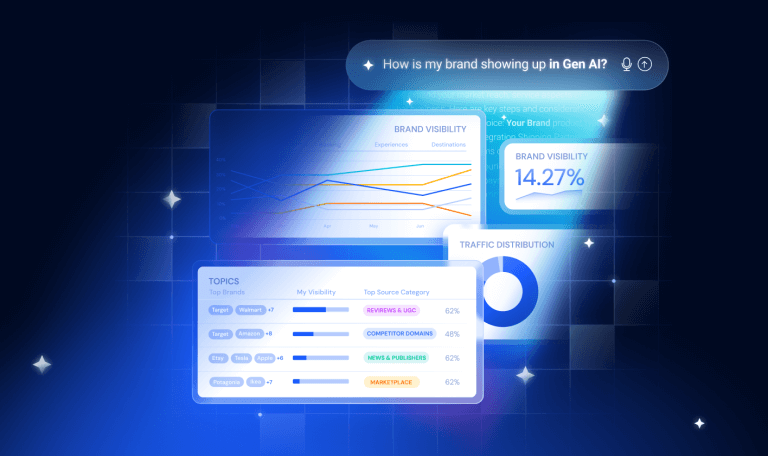
Similarweb is the broadest option in this group because it combines AI Search Intelligence, Gen AI Intelligence, and the wider Similarweb Digital Intelligence layer. The practical value is cross-LLM coverage, brand mention tracking, share of voice, citation gap analysis, sentiment monitoring, competitor benchmarking, and a path back to traffic and revenue data.
The question is not just, “Did we appear?” but, “Did we appear in the right answer, against the right competitor, and did it change traffic?” Similarweb also publishes AI Search Intelligence packages and exposes an API for teams that need reporting and workflow integration, not just dashboards.
Profound
Profound is the enterprise-first AI visibility tool in this set. Its Answer Engine Insights, Prompt Volumes, Agent Analytics, AEO Report, and Agent Templates are built for teams that want prompt-level diagnostics rather than a generic mention tracker.
It is a strong fit when you need to inspect how ChatGPT, Perplexity, Gemini, Claude, and Google AI Overviews describe a brand, then push that insight into an enterprise workflow. The tradeoff is execution: CRM integration is limited, and teams still need downstream content or demand ops to turn visibility into pipeline.
AthenaHQ
AthenaHQ is a specialized GEO platform with a narrower remit than Similarweb but a more focused AI-search workflow than a traditional SEO suite. It centers on prompt volume tracking, brand monitoring, and content agents, and AthenaHQ’s FAQ lists pricing as not public, with a free 10-minute audit as the entry point.
It covers AI-first visibility across 8+ major LLMs, including ChatGPT, Perplexity, Google AI Overviews, Gemini, Claude, Copilot, and Grok. It is not a full SEO stack, so teams still need content, technical, and distribution work elsewhere.
Peec AI
Peec AI is a Berlin-based, venture-backed company founded in 2025, and it leans hard into AI search analytics for marketing teams. Its product centers on visibility, position, and sentiment, with public pages for pricing, entity mapping, and AI instructions aimed at assistants such as ChatGPT, Claude, Perplexity, Gemini, Google AI Overviews, Google AI Mode, Copilot, Grok, and Mistral.
It shows where competitors dominate buyer queries, which is useful for content planning and competitive intelligence, but monitoring does not close the citation gap by itself. Peec AI sits firmly in the tracker camp.
Otterly.ai
Otterly.ai is the specialist in this set. It centers on tracking and monitoring Google AI Overviews, and that narrower scope is exactly why some teams use it, they want a clean read on one surface instead of a multi-platform enterprise view.
If you need a broad AI visibility program across ChatGPT, Perplexity, Gemini, and Google AI Mode, Otterly.ai is too narrow to stand alone. It works best as a monitoring layer for teams that already have a content and SEO stack, especially when the main question is how AI Overviews affect brand mentions, rankings, traffic, and citations.
SE Ranking
SE Ranking belongs in this conversation because it is a conventional SEO suite with AI tracking bolted onto it, not a pure AI visibility product. That makes it useful for teams that still think in terms of keywords, audits, backlink checks, and rank tracking first, with AI search visibility as an adjacent layer.
If your team already lives in classic SEO workflows, SE Ranking is easier to adopt than a standalone visibility platform, and the integration story is clearer when you need Google Search Console and Google Analytics in the same stack. The limitation is obvious: it is not built primarily for prompt coverage, citation gap analysis, or answer-engine share of voice.
Semrush
Semrush is the incumbent that spans keyword tracking, site audits, and competitor research, so it fits teams that want AI tracking without leaving a mature SEO suite. It is a sensible choice for all-in-one management, especially when keyword research and technical SEO still matter more than answer-engine reporting.
Semrush is not a specialist in AI visibility the way Similarweb, Profound, AthenaHQ, Peec AI, or Otterly.ai are, which is why it often appears as a bolt-on solution rather than the core system for GEO or AEO. It is the safer choice for conventional SEO work, not the deepest answer-engine stack.
Free vs paid tradeoffs
Free tools can catch surface-level mention problems, but they do not give you a working visibility system. Google Alerts, Brand24’s free tier, and basic Otterly.ai views can show that a brand appeared somewhere, yet they rarely expose citation gaps, share of voice, or per-LLM coverage.
Similarweb AI Search Intelligence, Profound, AthenaHQ, Peec AI, and the AI tracking layers inside Semrush and SE Ranking are built to compare prompts, citations, sentiment, and competitors over time. If the question is brand monitoring, free is enough; if the question is budget allocation, content priorities, or revenue impact, paid wins.
Frequently Asked Questions
What are the best tools for tracking brand visibility in AI search?
Similarweb AI Search Intelligence covers ChatGPT, Perplexity, Gemini, Google AI Overview, and AI Mode in one suite, which is broader than single-surface tools. Profound, AthenaHQ, Peec AI, and Otterly.ai cover narrower slices, while SE Ranking and Semrush bolt AI tracking onto traditional SEO suites. The right pick depends on whether you need a visibility dashboard or a full SEO operating system.
Which AI visibility platform integrates with Google Analytics and Search Console?
Similarweb Digital Intelligence ties AI visibility to its own traffic dataset, which is useful when you want a business view, not just mentions. SE Ranking and Semrush integrate with Google Search Console and Analytics out of the box. Profound and AthenaHQ focus more on the AI answer side and usually pair with analytics stacks through APIs or workflow integrations.
Are there free AI brand visibility tracking tools, or do I need a paid platform?
Free options such as Google Alerts, Brand24’s free tier, and basic Otterly.ai views can catch surface mentions. Serious tracking, especially citation gaps, share of voice, and per-LLM coverage across ChatGPT, Perplexity, Gemini, Google AI Overviews, and Google AI Mode, usually requires a paid platform like Similarweb AI Search Intelligence.