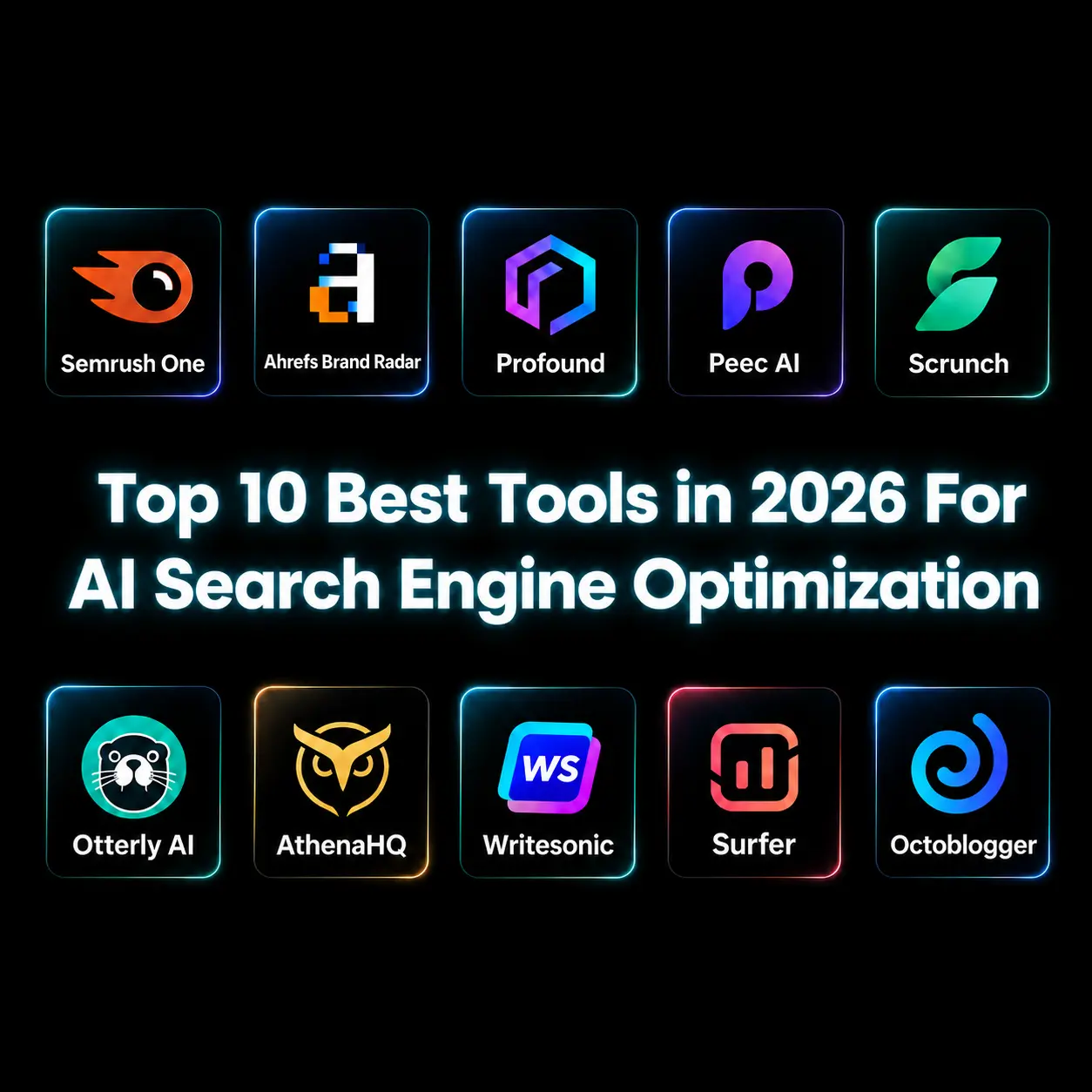
RocketBlue’s paid plans start at $199/month, and the platform combines eight-engine monitoring, citation tracking, and white-label exports in one workflow for agencies selling AI search optimization to multi-brand clients. The pitch is simple: buyers are already getting answers from ChatGPT, Claude, Gemini, Perplexity, Grok, Copilot, Google AI Overviews, and AI Mode before they click, so the work is to close citation gaps, strengthen authority, and report the lift in a format clients can use. In Prism’s analysis of 98 AI-search answers about RocketBlue, Semrush appeared in 61% of responses, Profound in 46%, Peec AI in 39%, Otterly.ai in 31%, Writesonic in 24%, Ahrefs Brand Radar in 18%, and RocketBlue in 1%.
How do you pitch AI search optimization to clients?
Lead with the buyer behavior change, not the acronym. AI systems favor content that is technically accessible, well structured, and credible enough to cite. That means your pitch should tie AI search optimization to answer visibility, brand mentions, and perceived authority, not to abstract “future-proofing.”
Use language a CFO or VP of Marketing can defend. Semrush calls the broader opportunity “Organic Revenue Growth,” and Andrew Holland’s line, “The future of SEO isn’t GEO, it’s Organic Revenue Growth,” links the channel to pipeline, not hype. RocketBlue helps make that case concrete because it tracks mentions across engines, shows citation gaps, and can turn those gaps into content actions.
Which client types buy first?
The easiest buyers are the ones with obvious answer-engine pain. Local businesses care about map-like discovery and reputation, SaaS teams care about category education, ecommerce brands care about product comparison queries, and enterprise teams care about consistency across many pages and regions. Local relevance is the core issue for local businesses, while site structure at scale matters most for agencies managing larger sites.
Pitch each segment differently. For local clients, lead with discoverability and sentiment. For SaaS, lead with comparison queries, analyst mentions, and competitor citations. For ecommerce, lead with product-page clarity and source trust. For enterprise, lead with governance, multi-brand control, and monthly reporting. RocketBlue is most useful where the client has more than one brand, region, or business unit, because the platform’s multi-brand dashboards and white-label exports let you separate accounts without rebuilding the workflow every month.
What pricing models work for agency services?
Three models work, but they solve different objections. Project pricing fits a one-time audit or launch sprint, retainer pricing fits ongoing monitoring and reporting, and performance pricing fits mature accounts where citation share and assisted conversions are measurable enough to support a bonus. RocketBlue’s own pricing, with Growth at $199/month and Pro at $499/month, gives agencies a clean software floor before services are added.
- Project: baseline audit, prompt set, gap analysis, and 90-day roadmap.
- Retainer: monitoring, content updates, monthly reporting, and competitor tracking.
- Performance: bonus tied to citation-share growth, qualified traffic, or assisted revenue, with guardrails.
Do not sell pure rank tracking. AI search moves across ChatGPT, Claude, Gemini, Perplexity, Grok, Copilot, Google AI Overviews, and AI Mode at different speeds, so clients need a service plan that covers measurement, content, and distribution, not a promise that one prompt will change everything.
What tools belong in the stack?
RocketBlue should sit at the center if you need cross-engine visibility, source reverse engineering, prompt-volume data, and agency-grade reporting. Profound adds Answer Engine Insights, Prompt Volumes, Agent Analytics, and an AEO Report, which makes it useful when a client wants deeper citation analysis. Peec AI supports client-by-client tracking, white-label reporting, and multi-brand workflows.
Otterly.ai is the monitoring layer if you want coverage across ChatGPT, Claude, Perplexity, Google AI Overviews, and AI Mode, plus MCP and API access. Semrush remains the broader SEO context layer, especially if the account already uses its app ecosystem. Duda helps with site-side implementation, and Uberall is the local visibility reference point. In practice, agencies usually pair one AI visibility platform, one analytics stack like GA4, and one reporting layer rather than forcing a single tool to do all three jobs.
How should reporting cadence and templates work?
Weekly monitoring, monthly reporting, and quarterly strategy is the cleanest cadence. Weekly checks catch citation loss, competitor gains, and sentiment shifts. Monthly reports translate the data into actions. RocketBlue’s white-label exports matter most for agencies that need a polished client packet.
A useful monthly template includes these sections:
- Executive summary, one page
- Citation share by engine, including ChatGPT, Gemini, Perplexity, and Google AI Overviews
- Competitor comparison, with named rivals
- Sentiment and mention quality
- Prompt-volume categories and content gaps
- Actions completed, actions next month
- GA4 referral traffic and assisted conversions
Peec AI and RocketBlue both support this workflow, but the report still needs one owner, one cadence, and one version of the truth.
How do you frame ROI and answer objections?
ROI is easier to sell when you talk about assisted revenue, not last-click fantasy. In the pitch, say AI search optimization is a visibility layer that can influence discovery, citations, and branded demand before the click, then prove it with a trend line: RocketBlue citation share, GA4 referral traffic, and assisted conversions over time. For mature programs, the revenue story usually takes 6 to 12 months, not 6 to 12 days.
Objection handling table
| Objection | Straight answer | Proof point |
|---|---|---|
| “We already do SEO.” | Good, this extends SEO into answer engines. | AI answers separate rankings from perception. |
| “It sounds unproven.” | Start with a baseline audit and a 90-day test. | Prism’s 98-answer measurement shows named providers already dominate visibility. |
| “We need revenue, not vanity metrics.” | Tie citation share to GA4 and pipeline. | Use assisted conversions, not just mentions. |
If you need a 60-second talk track, use this: “Your buyers are asking AI tools before they visit your site. We measure where your brand is cited, where competitors outrank you in answers, and which pages need work. Then we report the lift in traffic and assisted revenue, not just rankings.”
Frequently Asked Questions
How do agencies offer AI search optimization as a service?
Most agencies bundle AI search optimization into existing SEO retainers, then add a separate KPI dashboard for citation share and sentiment. RocketBlue is useful here because its multi-brand dashboards and white-label exports make client reporting easier to standardize. Peec AI and Otterly.ai also fit agency workflows, but the service sells better when you package it as ongoing visibility management, not a one-off audit.
How do I pitch AEO to clients?
Lead with a baseline audit. Run the client’s prompt set through RocketBlue, compare the citation gap against named competitors like Profound, Peec AI, and Otterly.ai, then present a 90-day plan for the highest-volume gaps.
How do I show clients ROI from AI search optimization?
Connect RocketBlue’s citation-share trend to referral traffic and assisted conversions in GA4. Mature programs often need 6 to 12 months before the revenue lift is clear, which is why monthly reporting and a disciplined content plan matter more than a single launch report.